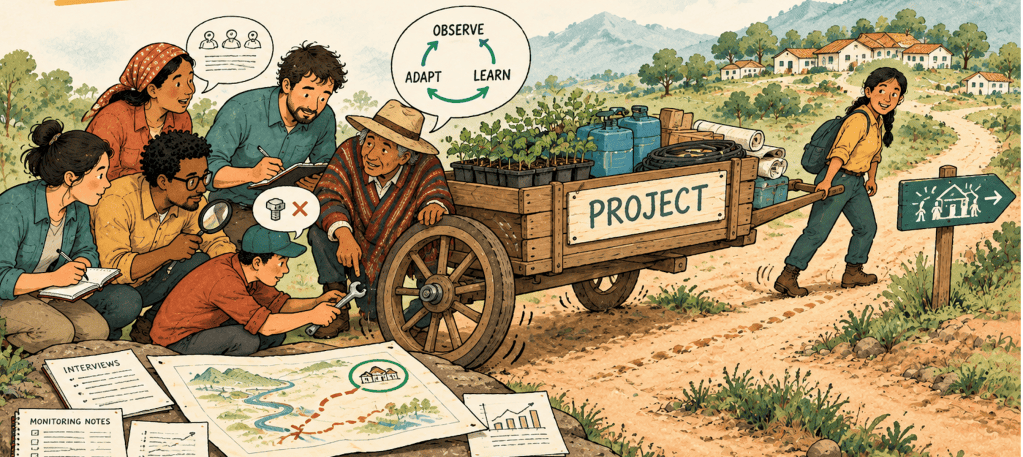
As part of my current role in a development programme in the Mekong, I was fortunate to attend a research workshop for a project, a four-year initiative working across Cambodia, Laos and Vietnam to strengthen the climate resilience of upland communities, with particular attention to ethnic minority women, young people and people with disabilities. That ambition makes research critical. But it also makes it necessary to ask what research is expected to do, whom it should serve and how it will relate to the difficult work of bringing about change.
I was offered the opportunity to speak about what I learned from hearing the people working together in the workshop. There were two groups– development practitioners working on the project, and researchers who worked alongside them to achieve certain outcomes.
Competence and Commitment
I began by discussing two things that I believe are critical to achieving any desired goal: competence and commitment. I learned these concepts some twenty years ago while reading Leadership and the One-Minute Manager by Ken Blanchard (and others).
Competence is our ability to do the work well. It includes knowing how to frame a research question, choose an appropriate method, gather and analyse evidence, recognise the limits of our claims, and communicate findings honestly. It is about rigour, but also judgement. A technically sophisticated study that answers the wrong question is not necessarily competent research.
Commitment is different. It is the willingness to stay with the work when field realities become complicated, timelines tighten and our early assumptions begin to unravel, revealing mistakes in judgement. It asks whether we are prepared to listen when the evidence contradicts what we hoped to find. It also asks whether we will remain accountable to the people whose lives appear in our transcripts, datasets and reports long after a workshop has ended.
Competence without commitment may produce a beautiful report that no one uses. Commitment without competence may yield enormous effort but unreliable findings. Development work needs both: the ability to do the work properly and the determination to make it matter.
Research in Development Projects: Three Types
In my experience, there are at least three ways research and implementation can relate to each other. These are not rigid categories, and one project may move from one relationship to another. Still, distinguishing them helps us be clearer about what kind of research we are doing and what we expect from it.

First, research drives the development intervention. We begin by seeking to understand the situation before deciding what to do. For example, research with upland farming communities may show that climate vulnerability is not simply a problem of inadequate technology. It may also be shaped by insecure access to land, limited market information, household care responsibilities, language barriers, or the limited voice of particular groups in local decision-making. Those findings should inform the intervention we design.
This is where research helps define the problem, identify who experiences it differently and surface possible entry points for action. It can prevent us from arriving with a solution before we have understood the world in which that solution must live.
This logic aligns with Problem-Driven Iterative Adaptation, which starts with locally felt problems, encourages experimentation and uses learning to develop contextually appropriate responses. The message is simple but often ignored: do not begin with the thing we are eager to deliver. Begin with the problem people actually want to solve.
Research in this first relationship is largely formative. Its purpose is not only to add to what is known, but to shape what will be done.
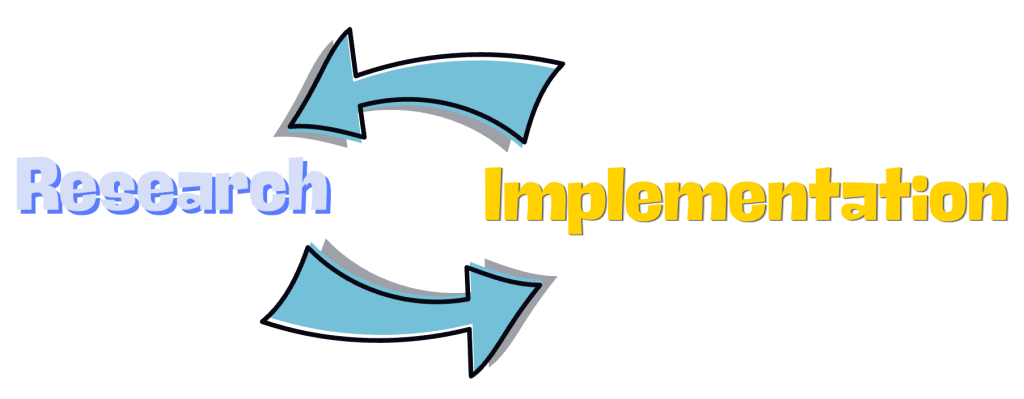
Secondly, there are cases when the intervention is already underway and research is called upon to answer a question or address a problem. Perhaps participation is lower than expected. Perhaps a climate information service is reaching village leaders but not women farmers. Perhaps a livelihood activity is technically sound but too costly to maintain. Perhaps the project is delivering activities on schedule, yet the expected behavioural changes are not occurring.
Here, research becomes diagnostic and adaptive. It helps us examine which assumption has failed, what is getting in the way and what needs to change.
Research can be embedded within implementation rather than conducted at a distance. Embedded researcher models place researchers within practice organisations to build relationships, understand institutional contexts, and help mobilise evidence for decision-making. The UK Climate Resilience Programme’s embedded researcher scheme, for example, placed researchers in host organisations to work on questions of mutual interest and treated climate science as one among several sources of decision-relevant knowledge.
This is also where monitoring, evaluation and research can become part of a genuine learning process. Evidence from USAID’s work on Collaborating, Learning and Adapting suggests that evidence is more likely to inform decisions when decision-makers help define what they need to know and participate in interpreting what the evidence means. The point is not to wait until the end to declare whether a project succeeded. It is to learn early enough to do something differently.
Research in this second relationship is problem-solving and adaptive. Its purpose is to improve an intervention while there is still time to do so.
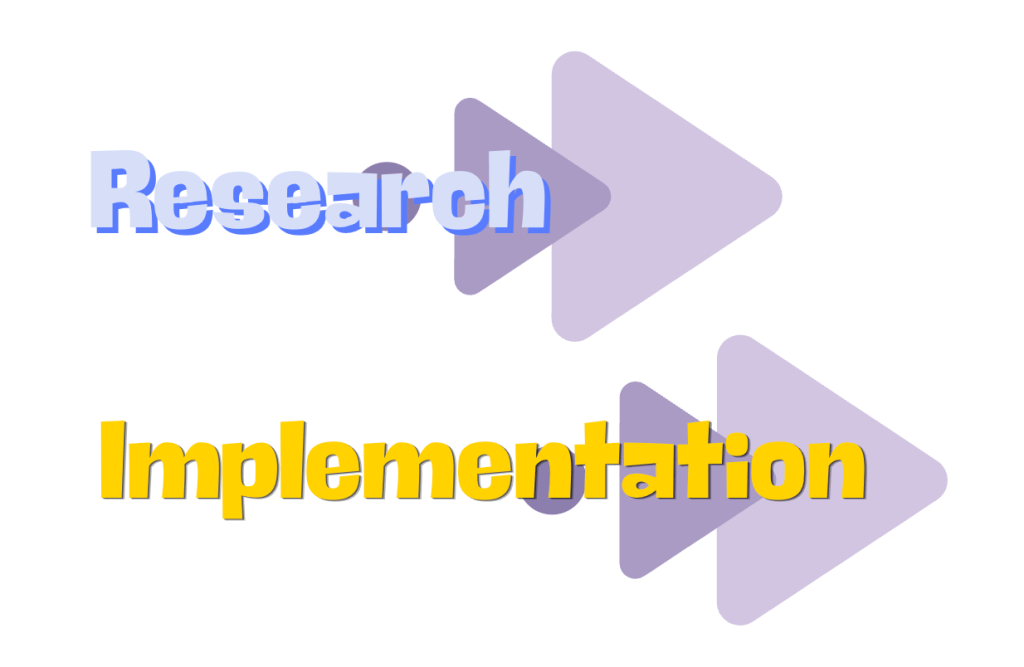
Finally, there may be instances when research and implementation occupy different lanes. The project implements its activities while a research team studies a related question. The two may share a thematic concern and geographic area, but the research does not directly determine the intervention and may not be designed to address an immediate implementation problem.
This is not automatically a weakness. Independent research can ask questions that an implementation team, preoccupied with targets and deadlines, may not have the time or freedom to ask. It can compare sites, examine longer-term changes, challenge the project’s own account of success, or produce knowledge useful beyond a single programme.
But parallel lanes can become separate roads. Researchers may produce findings only after crucial decisions have been made. Implementers may view the research as an additional reporting burden. Communities may repeatedly provide information without ever hearing what was learned or how it will be used.
Research in this third relationship is often independent, explanatory or knowledge-building. Its contribution may be less immediate, but it still needs to be made intentional. If the lanes are separate, we should at least build places where they meet.
Research for what purpose?
I am not advocating any particular type of relationship between research and implementation. But for every project implementer who works with research teams within their implementation processes, they need to clarify three more fundamental points.
What change do we want to see as a result of the research?
“We want to understand” is a valid starting point, but it is rarely sufficient for a development project. What will a better understanding enable someone to decide, change, stop, continue or do differently? Are we trying to redesign an intervention, influence a policy, improve resource allocation, strengthen community voice, or test whether an assumption holds?
A recent tool designed for research-for-development settings argues that intended research use should be considered throughout the study, not only at the point of dissemination. This means that a research-use conversation should occur while questions are still being framed, not after the final report has been written.
This is not just a question about the research audience. It is also a question about who participates in producing knowledge.
There is a difference between researching communities, consulting communities and conducting research with communities. People can help identify the problem, refine the questions, interpret findings and decide how results should be communicated and acted upon. Participatory action research places marginalised groups at the centre of knowledge production and combines inquiry with collective learning and action. Research–practice partnerships likewise seek to connect different forms of expertise and to give partners a meaningful role in decisions about the work.
This does not mean that everyone must participate in every task. It means being honest about whose knowledge counts, who holds decision-making power, who bears the cost of participation and who benefits when the study is complete.
In one of my earlier reflections, I wrote that it was not really about drip technology. The organisation emphasised the technology, but the farmers spoke more passionately about better planning, market knowledge, farm practices and buyer linkages. Listening changed what seemed important. Research should create room for that shift in perspective.
Finally, how do we want to undertake the process of achieving what we have set out to do?
The “how” is not only about choosing between a survey, a focus group discussion and an ethnographic study. It is also about the relationships we want to build, the values we want to uphold and the experience we create for participants. Will the process be extractive or reciprocal? Will findings be interpreted alongside the people concerned? Will outputs be available in formats and languages that participants can use? Will there be feedback loops between evidence and implementation?
The knowledge translation literature identifies a recurring sequence: identify and communicate the problem, develop or select relevant knowledge, analyse the context, and undertake activities that connect knowledge with users and support its use. In other words, producing findings is only one part of the journey.
The “how” must also align with our resources. Participatory work requires time. Translation requires money. Reaching remote communities requires logistical preparation. Building trust cannot be squeezed in between two project milestones. If we promise a process that our budget and timeline cannot support, our ambition can become another form of disrespect.
I closed my sharing with the participants with two wishes, and these are relevant not only to them but also to others undertaking the same approach.
First, I hope that the level of their ambition will be matched by the time and resources available to them.
I admire ambitious research. Ambition drives us to ask difficult questions, include people who are often left out, and look beyond easy indicators of success. But ambition must be paired with choices. A smaller, well-executed study that engages people meaningfully may be more useful than a sprawling study that spreads the team too thin. Scope is not merely a technical matter. It is an ethical one, because every promise of participation creates expectations and consumes people’s time.
Second, I hope it remains clear that they are not doing research for research’s sake.
Research can lead an intervention, help repair it, or travel alongside it. Its relationship with implementation may differ, and so will its approach and purpose. But in a development project, research should eventually return to the communities to whom the work is dedicated—not only as a report or a presentation, but as a better decision, a stronger voice, a more appropriate intervention, or a clearer understanding of what needs to change.


