A colleague at work once asked me how my perspective on leadership (and my behaviour as a leader) has changed over time.
A Shift in Pronouns
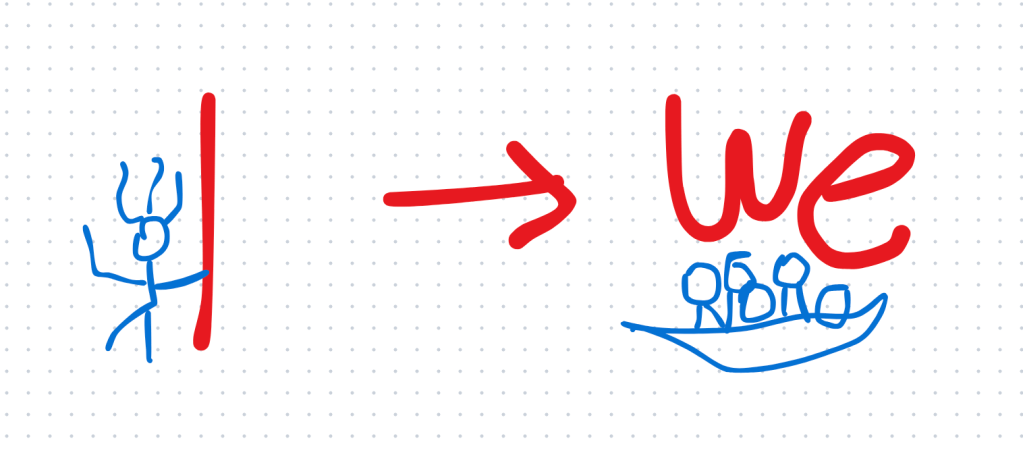
I reflected on this question quite a lot. Looking back, I realised that the change in how I view leadership can be best described by a shift in pronouns – a journey that began with “I” and has now moved to “We”. When I was younger, back in the days when I led student councils in junior high, I believed leadership focused on the ability, prowess, and capability of the leader to rally their team towards a shared goal. The leader depended on their own personal ability to achieve this and took full responsibility for both failure and success.
Later in life, my perspective on leadership shifted from this viewpoint to a “we” paradigm, where the leader elevates others and encourages collaboration towards a common purpose. This requires understanding one’s group members better, just as it requires understanding oneself. Understanding is crucial because it involves recognising that everyone has a role to play, that each person possesses strengths to harness in pursuit of a shared aim. Consequently, it demands more – sensitivity to appreciate and shape others, maturity to handle change and unchangeable realities, and agility to adapt approaches depending on the goal. There is no single formula, as “bringing out the best in people” shifts with the directions of the compass or the changing of the North Star. Furthermore, it signifies that success or failure is a collective responsibility, with leaders and members alike owning and sharing the vision as well as the methods to reach it.
Additionally, my view of leadership has shifted, as reflected in the change in how I measure success. Previously, success meant reaching a desired goal at any cost; the process might not have been inconsequential, but it was less important than the destination. Now, however, the metrics have shifted to the process of becoming – how each team member grows while working towards the goals. The focus is on both the journey and the destination, and the measure includes not only the quality of the output but also the quality of the experience.
How my Parents Influenced my Views on Leadership

My parents have had a tremendous influence on the way I view the world and how I lead my life and others’.
My father is the perpetual optimist, the go-getter, the person who sees a crack in some closed door or window. He was very resourceful, not only in terms of finding the necessities to undertake a task, but also in discovering the appropriate method to achieve a desired outcome. He is a highly skilled auto-mechanic, renowned for his ability to solve problems at a time when digital diagnostics were not yet available. I see in him the ability to truly ‘listen” to the customer, to his service team, and to the different needs and suggested solutions, weaving them into a cohesive problem-solving approach. I observe his capacity to hold multiple perspectives and identify the converging points that yield the most cost-effective and efficient solution.
I have tried very hard to mimic this ability in my work. I engage with the customer — what they want is more important than the solution I can offer. I also talk to my team and harness collective insights in the problem-solving process. I equip myself with tools and frameworks rather than relying on ready-made solutions or repeatable insights.
My mother is a sensitive and caring person. Her quiet humility is inspiring—her ability to approach a task with a blank slate and a solemn recognition of nothingness. While she has many ideas, she treats challenges like an empty canvas—by the way, she is an artist, paints very well, and perhaps this approach is influenced by that. So, she senses the situation, interprets it, steps back, reviews the process, then formulates her approach—the colours to use, the brush strokes needed, the overlays and underlays necessary to achieve the best result. This sensing, or sense-making if you like, is only possible because she starts without pre-conceived notions.
She also cares deeply for her family, prioritising her individual members’ interests over her own, and in doing so, manages to achieve the collective good. She publicly recognises people’s achievements, as if those individuals are her own kin. She praises with words and reprimands through actions. I try to emulate this humility and passion for caring in my teams, giving more praise than reprimands. I wouldn’t say I’ve succeeded, but I am certainly making progress.
Learning to be Better
To be honest, I try very hard to lead effectively. To learn strategies and approaches for effective leadership, I do at least three things.
First, I read the masters – those who have excelled in this field of leading people and achieving great things, and those whose approach to leadership I am completely opposed to. I read works from Richard Bach to Ken Blanchard to Scott Adams to Nancy Kline to Susan Caine to Tom Kelly and so on.
Second, I take on new and challenging roles either in society or within an organisation at least once a year. I have led a non-profit board, a publishing house, a political party, a local community group, a church organisation, an advocacy group, a multi-disciplinary research team, an alumni board, and so forth – each offering a different context, dimension, belief system, and purpose – making the journey of discovery both exciting and challenging.
Third, I observe and shadow people and organisations in various roles—such as researcher, diplomat, or consultant—to understand how leadership and followership unfold in real work situations. I have conducted ethnographic and observational work within large corporations, law firms, aid agencies, government offices, farmers’ groups, women’s organisations, banks, among others. I have observed that leadership challenges appear similar across contexts and that individuals respond differently to various provocations.
Things I Would Have Done Differently
If there are three things I regret not doing in life that could have potentially shaped my views and experiences of leadership differently, these are them.
First, I could have started early on acquiring international education. I didn’t really consider this until I was in my mid-20s. Second, I could have remained in the private sector, at least for a while. I was a cost accountant at a power company and was well paid for a few years. I just didn’t find it meaningful, perhaps because it was a challenging role that required many sleepless nights, and it focused more on spreadsheets and analytics than on people. If I had stayed, I could have become CFO. However, I would say that when I switched to teaching, it became one of the most meaningful and personally fulfilling jobs I have had.
Finally, I could have explored joining international organisations earlier in my career, but it really did not occur to me that I had the capacity to do so. Nevertheless, my work in local communities has shaped me to be grounded in local realities and to find meaning in the seemingly ordinary.
My journey and views of leadership is far from finished despite my relatively advanced age. I remind myself, all the time, that leadership is not a destination but a practice, shaped by every encounter, organisation, and experience. While I may never feel I’ve fully arrived, I am grateful for the chance to keep striving, keep caring, and keep cultivating a sense of purpose, both for myself and those I have the privilege to lead.

 Michael "Miko" Cañares