I grew up in a small town in northwestern Mindanao, in the Philippines. As an introverted person, I chose to go out in small groups and have a very tightly-knit circle of friends since I was a kid. My choices, in a lot of ways, are influenced by my penchant for up-close relationships and an arms-length study of the social and material world. To be in a small subset of a vast world makes me appreciate the minute details of the every day. It makes me find beauty in the granularity of things.
But then I received criticism from my friends several times.
Somebody said I wanted to be in small settings because it made me feel comfortable. They said staying in small settings represented my inability to take significant risks and my affinity for the easy, the less challenging, and the more controllable life.
Another person said that it made me feel powerful because in my small world, due to a lack of sufficient competition, I wielded the power that I needed. My ability would not be tested until I venture into the wide-open sea. They said that staying small was all about my insecurity – because I know deep inside that I would never be able to compete when I would be out there.
Finally, somebody said that thinking small, or what he said pejoratively as my brand of small thinking, was a testament to my inability to situate my pretentiously focused thinking in the larger scheme of things. He told me the right attitude should have been to “think globally, act locally”.
So, I tried to embark on a journey of thinking big: big issues, world problems, state-of-the-art technology, trends of the future, and global discourses. I ventured into the wide-open sea, as my friends call it.
True enough, I felt small, inadequate, barriotic, and inept. I became more aware that I knew too little and strove hard to learn more. It was a good experience, allowing me to see new things and sometimes view old things in a different light. It also pushed me outside of my comfort zone and encouraged me to try new approaches or do familiar tasks differently. I was able to, as one of my favourite anthropologists, Tanya Li, would call it – zoom in and zoom out – connect my on-the-ground observations with wider dynamics that impinge on ordinary people’s lives – world trade, global capitalism, amongst others.
Subliminally, I avoided thinking small, because I initially thought my friends were all correct with what they said. But the more I did so, the more I realised that while they were right in saying so many things about the limits of thinking small and looking at the granular details of everyday problems in communities and individuals, they were also wrong about dismissing it in a way Daniel Immerwah talks about this in his 2018 book. To be fair, the book Thinking Small is not necessarily a critique of the concept, but rather the way the concept is finding its way to local initiatives on ground.
Thinking in small subsets is entirely wrong when it is void of consideration of the larger ecosystem in which such a small subset operates. Immerwah discusses this in his analysis of community development in the Philippines, where even though there were laudable initiatives, it did not consider inherent power structures that are culprits of further deprivation and that are oftentimes operating outside of a small community, at the regional and national levels of power.
And this is where thinking small, with a clear and wholistic view of the wider system where the individual, a family, a group, or a community operates, is important. It is like Tanya Li’s work in South Sulawesi, where the micro-level ethnography meets macro-level structural analysis; where for example, there has to be an analysis of structural, and oftentimes global drivers of poverty and marginalisation, and the local decision-making processes of those affected.
I still believe, that without grounding our understanding of biggish concepts in the everyday realities of people, we will fail to understand better the world we live in. In the same way, solving community problems by focusing on placed-based issues and causes, will hardly become possible, without considering the wider dynamics at work.
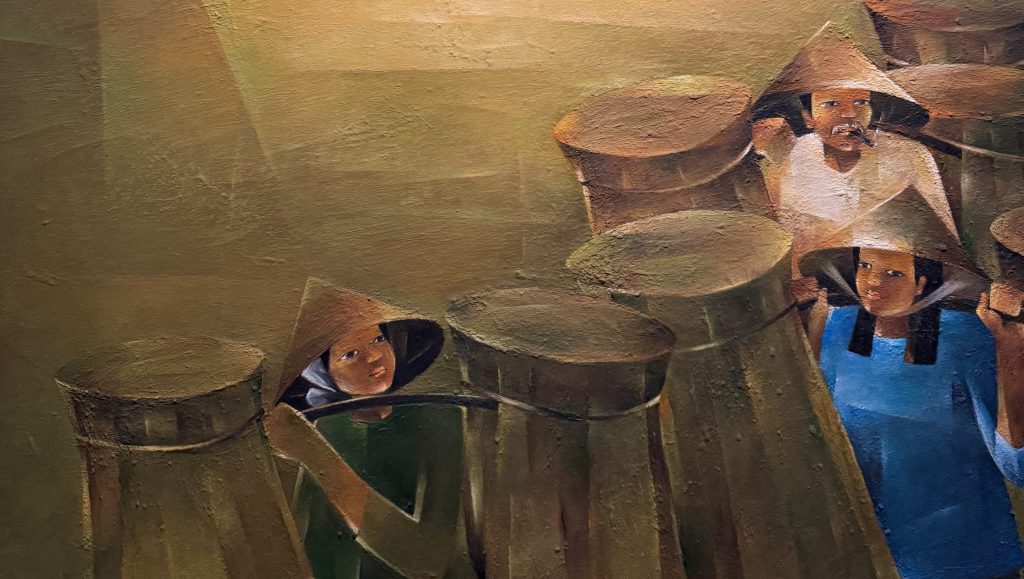
(The artwork above is the lower portion of Worries Still Remain, Than Trung Dung, 2004)

 Michael "Miko" Cañares