I was in Nanyuki when I had an interesting conversation with somebody passionate about documenting learning conversations. I argued that learning conversations—those that you do with people (in organisations) to reflect on their experiences and realise the implications for the future—should be used to inform strategic thinking and the strategies of organisations. She did not seem to agree.
As a concrete response to her doubts, I designed a process called From Learning Conversations to Strategy to test my thoughts. I tested it with an organisation I worked with early in the year to design learning conversations to harvest programmatic learning. For four months, the team conducted over twenty learning conversations of two cycles each and documented the results in two-pager templates. The question then was how to process these results to inform their future work—thus, the conversations to strategy frame.
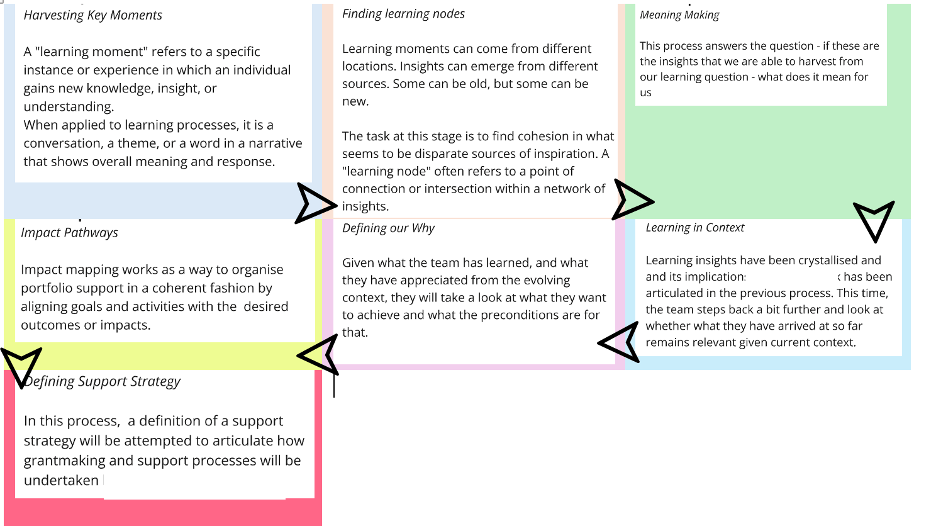
The process I designed consisted of seven steps that I would like to discuss in this post, and I hope to hear your reaction and comments. The seven steps were:
- Harvesting key moments
- Finding nodes
- Meaning making
- Learning in context
- Defining our way
- Designing our impact pathways
- Defining the strategy
Step 1: Harvesting Key Moments
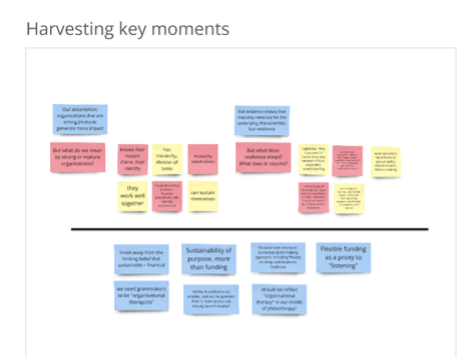
For me, a “learning moment” refers to a specific instance or experience in which an individual gains new knowledge, insight, or understanding. When applied to learning processes, it is a theme or word in a conversation narrative that shows the overall meaning of a person’s response—his/her core realisation, the ‘aha’ moment.
To conduct this process, the several learning conversations conducted must be documented and summarised, so it’s easier to harvest those that are prevalent, pervasive, and primordial. At the very basic, this step tries to answer the question:
- What themes, issues, words, and phrases are shared across the learning conversations?
- What themes, issues, words, and phrases seem to be fundamental or foundational in understanding the world?
For the team I was working with, I generated summaries of our learning conversations with different respondents and groups. I gave the summaries to the team and had these as a reading assignment before we gathered in a workshop, where we reflected on the conversation results and did a “harvesting” of “key learning moments”.
Step 2: Finding Learning Nodes
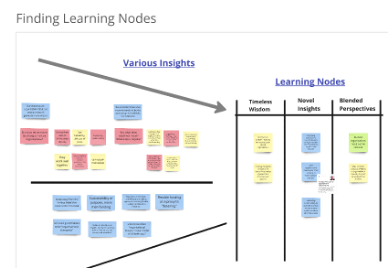
Now that we have identified “key learning moments” from the conversations, the next task was to find learning nodes among the many themes that emerged. The primary question we wanted to answer is: What themes, issues, words, and phrases are widespread and seem to connect the different learning moments?
For me, a “learning node” refers to a point of connection or intersection within a series of seemingly disparate insights. To find learning nodes, we need to examine the different key learning moments and identify their interconnections and the ideas and principles that hold them together. We already had the learning moments identified, so in this session, we sat together, traced interconnections, and identified key nodes underpinning the learning insights that emerged.
This step acknowledges that learning moments can come from different locations and that insights can emerge from different sources. Our task at this stage was to find cohesion in what seemed to be disparate sources of inspiration.
Step 3: Meaning-making
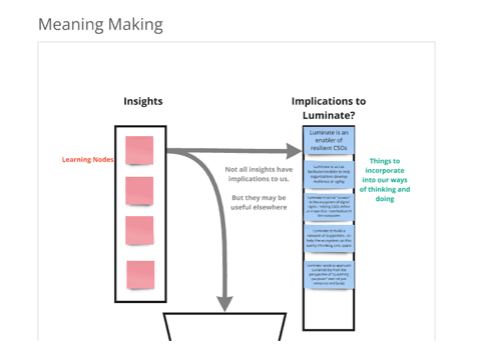
We have the learning nodes now, but what’s next? The next step was to examine the emerging learning nodes and articulate their implications for the organisation. More specifically, we answered the following question: If these are the insights we harvest from our learning question, what does it mean for us as an organisation?
This narrative-building exercise followed the following format:
We learned that it is ______________________, this means that in our organisation, we need to _____________________. I think this is the case because _____________________.
Each team member took turns building the narrative based on the learning node that resonated with them significantly. We ended up with many realisations and actionable areas, including what barriers to unlock, what opportunities to take advantage of, and what specific action areas to prioritise.
Step 4: Learning in Context
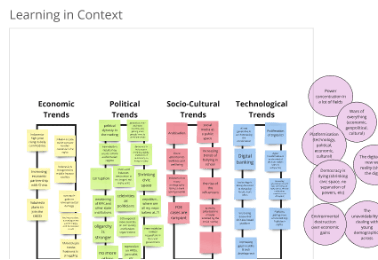
The major limitation of learning conversations is that they are time-sensitive, meaning they may likely be relevant when the data are collected. Thus, to ensure that the learning nodes are still relevant to changing circumstances, we need to situate them in the realities of the current context. In this case, we embarked on an exercise called “learning in context.”
Process-wise, we have already crystallised learning insights and their implications for our work. This time, we stepped back and considered whether what we have arrived at remains relevant given the current context. We did this through a quick context analysis, looking at at least four dimensions: economic, political, socio-cultural, and technological.
The exercise was a quick and dirty context review. Each team member was asked what they had observed across these four dimensions. After we exhausted all ideas, we looked at our output, summarised key contextual issues, and reflected on whether our learning nodes were still relevant given these contextual realities.
Step 5: Defining our Why
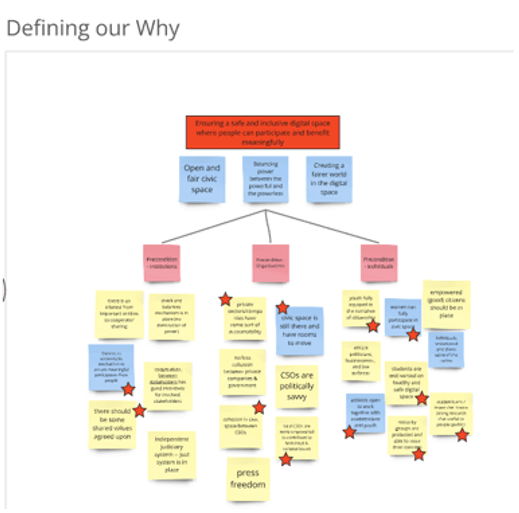
Given what we have learned and appreciated about our evolving context, we looked at what we want to achieve and the preconditions for that, and whether what we have learned impacted our sense of purpose and our thinking of how change happens. We wanted to answer the question, “Is our purpose still relevant?” Have the learning conversation results altered the way we view the world and our role in it?
Interestingly, while the mission or purpose remains relevant, the perceived role has changed, given what the learning conversations have led us to. Given the change in our view of our roles comes the change of looking at pathways to get ourselves to full alignment with our sense of purpose.
Step 6: Designing Impact Pathways
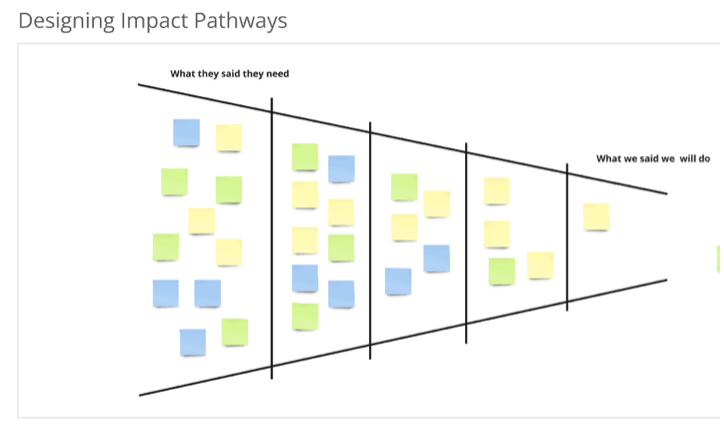
In the previous exercise, we affirmed what results or impact we would like to achieve. The following process then defines how we can get there – the impact pathways.
Designing impact pathways involves mapping the sequence of changes necessary to achieve the desired impact and creating a visual representation or a narrative of how interventions will lead to long-term results. By mapping these steps, the team increased their understanding of the complex interactions and dependencies among activities, revealing the “pathway” of influence that connects individual interventions to broader objectives. The impact pathways identified helped the team see the logic behind their work and allowed for a shared understanding of strategies.
Step 7: Redefining the strategy
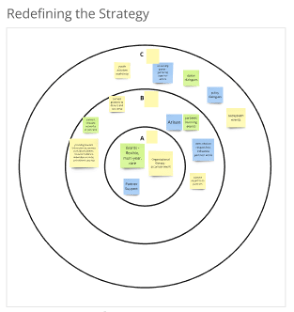
The organisation where the team belonged already had a strategy, but how can the results of the previous steps inform how the strategy needs to be refined, replaced, or reformulated?
The previous steps have helped the team revisit and have a fresh perspective on the goals (Step 6), the evolving context (Step 5), and the methods of journeying towards the goal (Step 7). It helped the team take a step back to assess if the existing approach aligns with the evolving context and needs. The previous steps also helped the team to question the foundational assumptions that shaped the original strategy and critically evaluate whether these assumptions still hold. Redefining the strategy helped the team clarify priorities and ensure that resources are directed towards interventions supporting the desired long-term impact.
The overall process has helped redefine organisational strategy. The learning conversations conducted with various stakeholders—partners, thought leaders, analysts, scholars, and collaborators—refined the team’s thinking of its strategy. The goalposts have not changed, but certainly, the ways of getting there have significantly changed, prompted by a new appreciation and understanding of the organisation’s necessary role in the ecosystem.
Does the process, as described above, make sense to you? Let me know.

 Michael "Miko" Cañares