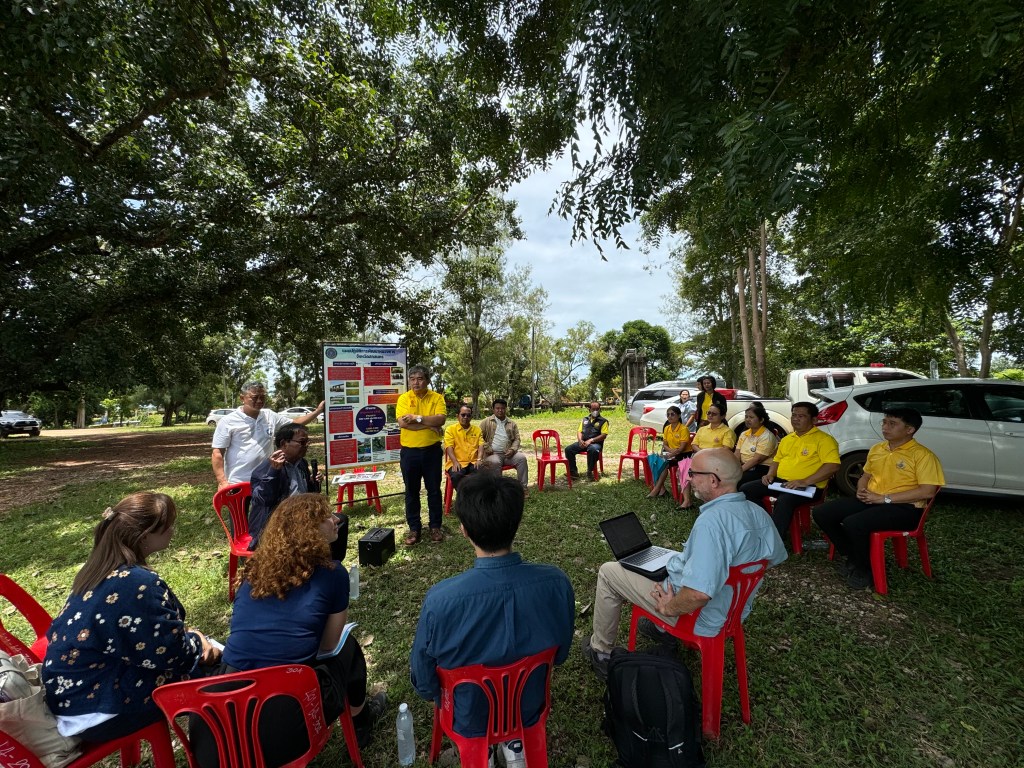
I was surprised when a friend of mine said that he likes monitoring visits because it gives him the opportunity to go out of the office, travel, meet new people, and relax. Well, the first three parts, yes, but the last one? Definitely no. I think there is that common misunderstanding that field visits are just that – visit partners, take a look at their projects, talk with people, and go home. But at least from my perspective and experience, it is a costly exercise, not only to the organisation that you work for (e.g. travel costs), yourself (e.g time away from home and family) but also to the environment (e.g. CO2 emissions from flights). Apart from being costly, field visits, when done properly, requires thinking through the different processes you would like to do while on the field and speaking with partners.
This is the reason why for me, field monitoring visits need to be planned well by asking at least 5 questions: (1) when is the best time to go, (2) what you need to do prior, (3) what questions should guide you in conducting your field visit, (4) what you need to do during the visit, and (5) what you have to do after.
When is the right time to conduct monitoring visits?
When projects are currently under implementation, project managers should conduct field visits. The following can be triggers for conducting field visits:
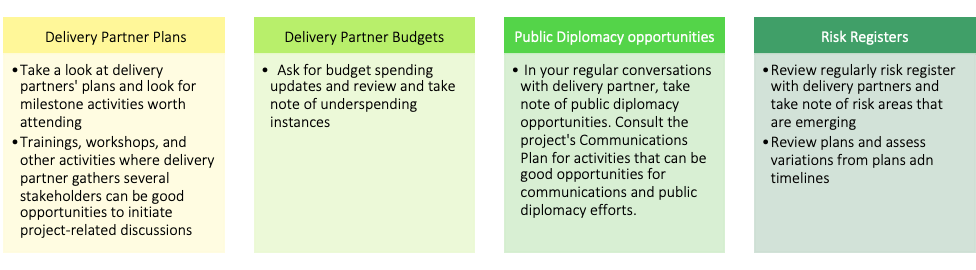
What do you need to do before conducting field visits?
- Discuss objectives of the visit and seek clearance from your manager. Objectives can be about assessing the
- Quality of partner and participant engagement
- Progress and quality of activities and results
- Efficiency and effectiveness of resource use
- Inform the delivery partner odf the planned visits, its objectives, and plan together for the best use of your and their time. Agree on date and schedule at least a month in advance.
- Deal with administrative arrangements (e.g. flight and hotel booking, cash advance). Write an information sheet detailing the objectives of visit and assistance needed from delivery partner, when relevant.
- Finalise a field visit plan that includes:
- Projects/areas to visit – select those that can potentially show the progress of the project or the lack thereof.
- People to meet – should include a mix of delivery partner staff, local government partners, project participants, and other relevant stakeholders (e.g. partner donors). Be mindful of GEDSI principles in the selection.
- Questions to ask (see below)
- Ensure that before you leave, you have reviewed:
- Signed agreements
- Project design
- Progress and financial reports submitted
- Risk registers
- Project plans
What questions should guide you in conducting your field visit?
Below, I list down some important questions to choose from. I categorised them into four – design and contractual agreements, inputs, results and learning, and next steps.
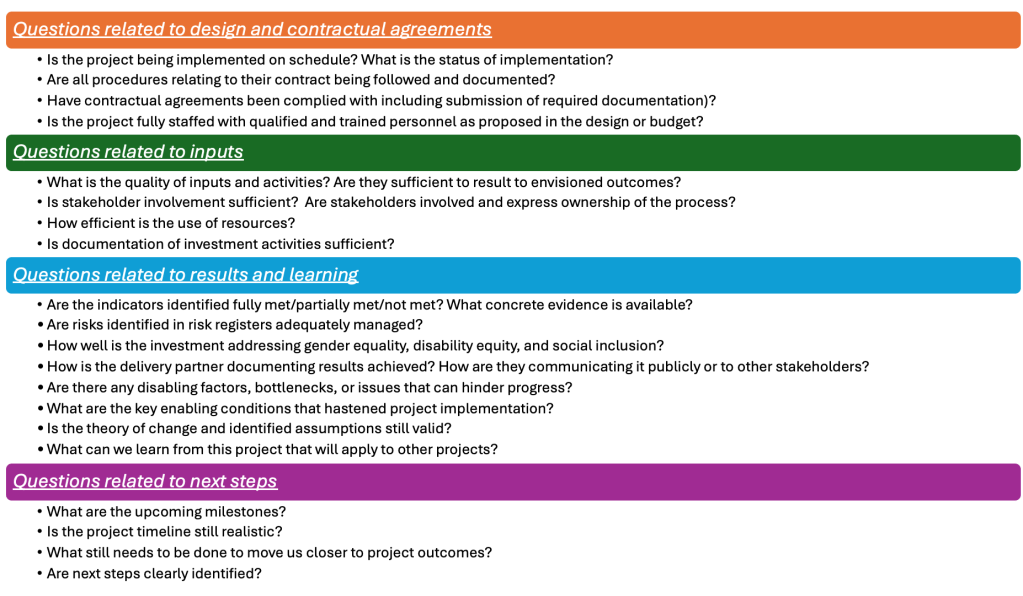
The above questions are questions you need to carry with you in your head. Several of these need not be asked directly. For example, the question “What are the key enabling factors that hastened project implementation?” is a question that can be answered using a combination of sources – what you see on the field from your observation, what people say to you when they explain what has happened, or what were indicated in project reports.
What should you do during the field visit?
Stick to the plan but be agile and responsive. Focus on your objectives. Plans normally indicate how you would like people to be involved in the field visits and how much time you are asking from them. As much as possible, make sure that you stick to the plan so as not to waste people’s time. For example, I was in a field monitoring visit where participants have to wait for at least an hour and a half for the field visit team to arrive in a community center. For me, this is utter disrespect of people’s lives! Also, if you commit to be there, do not cancel schedules. As much as possible, honour people’s time. However, things may change and schedules may be shifted from one day to another but do allow sufficient notice to people involved. Allow some flexibility in processes – focus on your objectives. The “how” can be negotiated, just make sure that you have your sight aimed at the reason why you are there.
Document everything. Have that notebook, recorder, and camera handy. The biggest mistake is to come to a visit without a pen and a paper to write your observations, people’s thoughts and opinions, and the overall result of the visit. I am old, so I tend to forget a lot of things. So I make sure that I write down everything. If you need to take pictures, do so with permission, especially if it involves people (or what they call human subjects, a term I hate). If you want to capture people’s views as they are said, ask them if you can record them (using your voice recorder or phone) as they speak.
Be kind, polite, and intentional in your questions. Most field visits are about conversations. When you talk to partners, project participants, or project staff, it is important to be kind and polite. Your being there, disrupting their regular workflows, is already a stressor in itself. Be patient with your interviewees. Also, don’t ask questions for the sake of asking questions. Ask questions with the intention to clarify and understand better, than to fault-find.
Ensure that you do post-field visit reflection with everyone involved. Field visits involve several stakeholders, with probably different appreciation and opinion of what they have observed together. Doing a reflection with everyone involved is a useful exercise to reflect on people’s observations and assessments, as well as crystalise learning from the visit to inform future directions.
Remember that you represent the organisation that you work for. Don’t do anything that will create reputational risks for yourself and for the organisation that you represent. Don’t ask for things (e.g. sample products, plants for your garden) or accept gifts.
What do you need to do after the field visit?
I strongly advise to write field monitoring reports after the field visit. This is something that you can use to communicate with your superio or with other team members. To do this effectiely, you need to organise your field visit notes according to the objectives you have identified at the beginning. You may also want to share it with the delivery partners/project managers for their comments and to ensure that you are capturing the results appropriately. It may also be useful to discuss the results with your immediate superior, highlighting key action areas that emanate from the visit. The following key themes below are the ones I usually include in the field monitoring report.
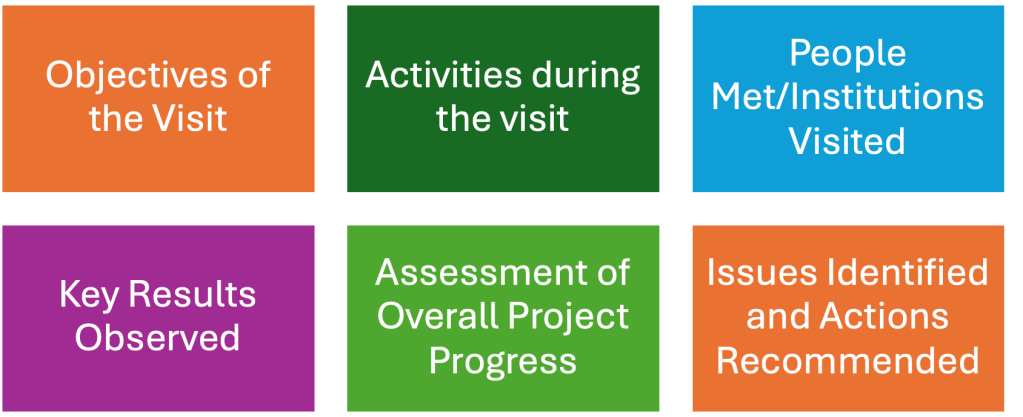
These are the things I consider critical and important. How about you?

 Michael "Miko" Cañares