
I visited WWF-Australia’s floating rice project in the Mekong Delta. There, they used agricultural drones to plant floating rice over a hundred hectares of flooded wetlands, working with farmers to adapt the innovative practice and learn from the process. I was amazed at the level of innovation and the insightful use of data to inform decision-making at the farmland level.
Interest in Frugal Innovation
I have been fascinated with the concept and use of frugal innovation for two years, deciding it to be the main topic of my Phd research at Bangkok University. Frugal innovation is a type of innovation that produces relevant solutions to persisting problems in resource-constrained situations ((Dabić et al., 2022). It has gained traction in recent years because it results in valuable, affordable and environmentally sustainable products and services for people living in low-income countries (Hossain et al., 2021). At the same time, frugal innovation is argued to create economic opportunities for small and medium-sized businesses, thereby accelerating entrepreneurship and contributing to economic growth (Knorringa et al., 2016).
But why do frugal innovations emerge? An extensive review of the literature surfaces several triggers for frugal innovation to emerge. This includes personal drive – including the desire to make lives better; business drive, like the existence of product gaps, market gaps, and innovation gaps; and social drive, such as the need to fight poverty, social injustice or hunger (Hossain et al., 2022). The intersection of intrinsic motivation and the demand for public social goods, despite a resource-constrained context, provides open spaces for innovators to create products and services of value. It is important to point out, in this case, that frugality is both an enabling context and a driver (Ploeg et al., 2020), and when matched with required capabilities, sufficient design, managerial competencies, technical and financial support, and enabling local policies, will yield results that address the need that triggers the innovation in the first instance (Niroumand et al., 2020).
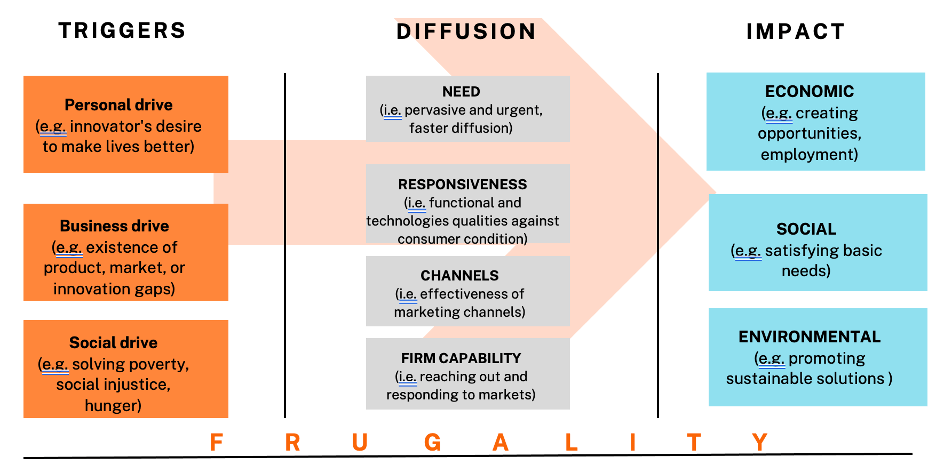
But the diffusion of innovation is not necessarily automatic, despite the success of initial experiments. There are at least four factors that influence diffusion patterns (Hossain et al., 2016). First, the need for innovation hastens faster diffusion. When the need is pervasive and urgent, diffusion will likely succeed. Second, the functional and technological qualities of the innovation is important, relative to the condition of consumers. For example, in poor communities with low level of literacy, cheap, local, and simple to implement solutions are adopted widely. Third, marketing channels are found to be critical factors in widespread adoption. The manner by which a resulting innovation is introduced, and the pathways of persuasion are constructed, are significant factors in the ability of consumers to adopt a new product or service. Finally, the capability of innovating firms not only to create products or services, but also deal with the attendant tasks of reaching out to markets, will have a significant impact on overall diffusion of frugal innovation.
Frugal innovation does not only create products and services or new markets and organizational practices – it also has wider impacts beyond production and market penetration. In a review of case studies tackling frugal innovation and its attendant impacts, there are at least three main impact strands of frugal innovation. First, frugal innovation contributes to local economic development by creating opportunities for inclusive entrepreneurial growth and consequently providing employment opportunities. Second, frugal innovation contributes to social, environmental, and economic sustainability by satisfying basic needs, addressing environmental concerns, and promoting sustainable economic growth. Finally, frugal innovation contributes to building inclusive markets where the poor and the marginalized are seen as customers worthy of innovative responses and problem-centric solutions (Sarkar & Mateus, 2022b).
Data-Driven Frugal Innovation
But my interest goes beyond just frugal innovation. I am more interested in how data is being used in the development and implementation of innovative frugal solutions.
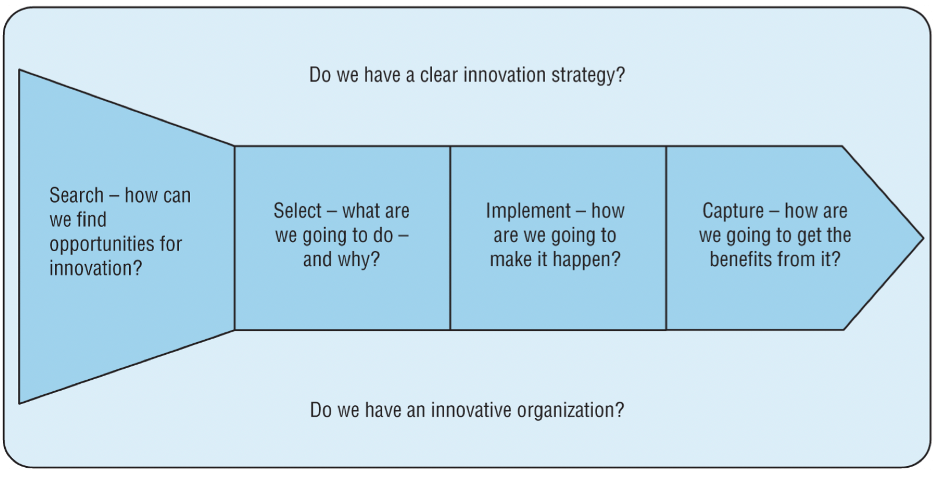
True, the importance of data in innovation processes cannot be discounted. In the innovation journey (see figure 1 below), data and information is an integral part in searching for opportunities for innovation, in selecting which of the innovation triggers a company need to respond to, and even up to the point of harvesting learning from the process (Tidd & Bessant, 2020). But with recent advances in technology, impacting how data is collected, aggregated, and stored, there is a significant change in how data plays an integral role in innovation process.
The earliest definition of data-driven innovation was provided by the OECD in a seminal publication published in 2015. Data-driven innovation is defined as “significant improvement of existing, or the development of new, products, processes, organizational methods and markets emerging” from close-to-real time large volumes of data (OECD, 2015, p. 17). While the report focused largely on big data and its use in macro-level innovation economy, data-driven innovation can still occur in micro, individual, and company-level processes (Andersen & Pedersen, 2021). At the same time, at the core of data-driven innovation is data, and innovation happens as a process of converting data into valuable products or services (Cronholm & Andersson, 2020).
Recent examples of data-driven innovation have been documented by various scholars in recent years, including, for example, data-crunching on energy consumption data to rationalize energy consumption and suggest to consumers a suite of energy-saving practices as the case of OPower ((Jetzek et al., 2014); the use of large-scale semantic analysis to design superior lithium-ion batteries by IBM (Luo, 2023); or an app that monitors the impact of coffee-drinking to personal well-being as in the case of UpCoffee (Trabucchi & Buganza, 2019). In several of these examples, the ‘raw material’ data from where the innovation is produced, are usually big data and open data, the former conditioned by the proliferation of mobile technologies, including mobile phones, and the latter prompted by the publication of open data sets, largely by government, as a result of the transparency and accountability agenda impacting public sector agencies globally.
Data is used in frugal innovation as a basis for developing products and services. For example, data is used to create innovative products, like in the case of India where direct observation and data on menstruation practices resulted to the development of a small-scale machines that produce sanitary napkins for rural women in India (Hossain et al., 2021). In other cases, data is an integral component in prototype development and testing. For example, in South Africa, data from interviews and conversations with potential target market informs the further shape of a service innovation in 3d printing in South Africa (Nilsson et al., 2022). Sometimes, data is an output of the innovation, as in the case of an electronic supply monitoring device in India, where data from devices that record electricity fluctuations are used for power generation advocacy (Canares et al., 2017). But there is scant literature on the use of data, as a ‘raw material’ in the context of frugal innovation; there are only very few publications that deal with data-driven innovative products and services.
Next Steps from Here
In the coming weeks, I will dive more into the topic, looking at specific examples of what I refer to as data-driven frugal innovation. My initial definition of the concept is that this is innovation that produces satisfactory products, processes, and services developed using data and directly targeting user requirements for simple, affordable, and sustainable solutions in resource-constrained environments.
I will explore this initial thinking more and will write things as I find.

 Michael "Miko" Cañares